
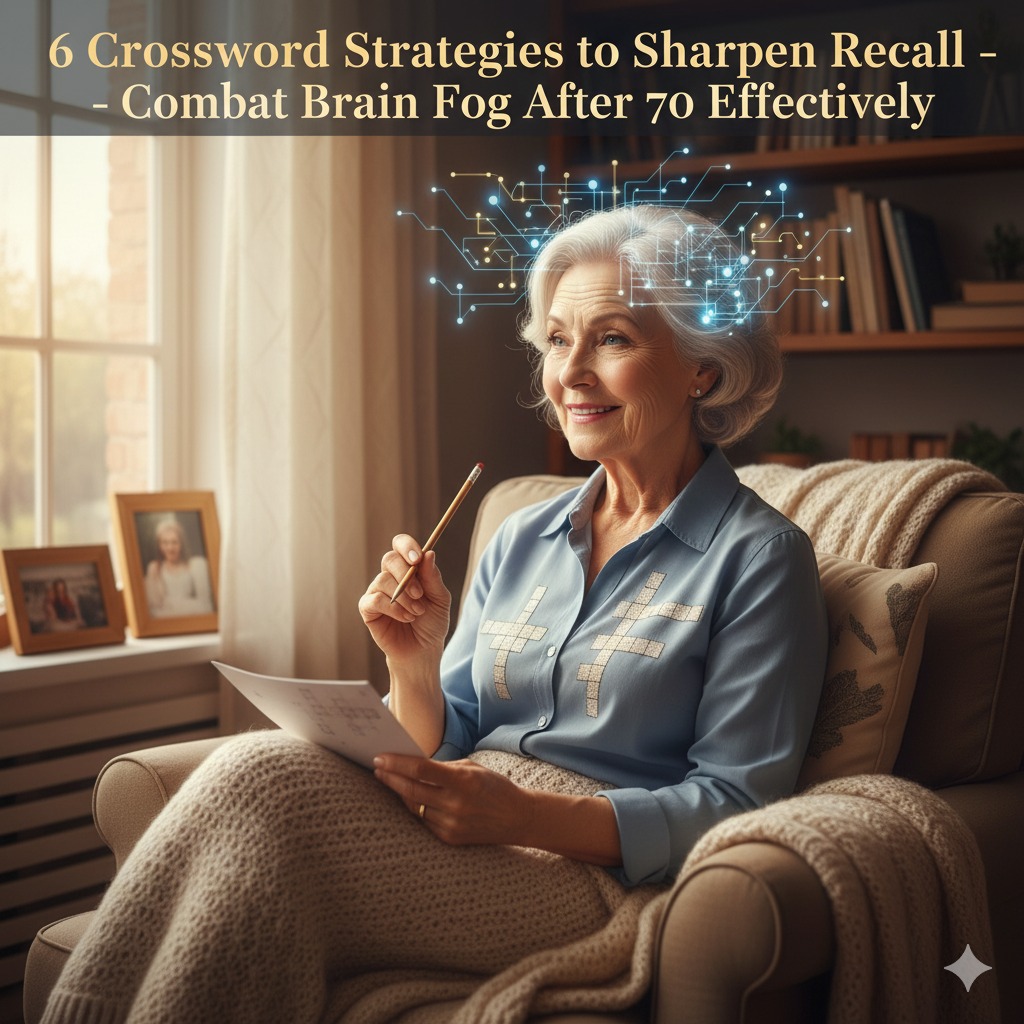
Phew, another Monday morning, and you’re trying to remember where you put your reading glasses, right? Or perhaps you found yourself staring at a familiar face, struggling to recall their name, even though you just spoke to them yesterday. It’s a common experience as we journey through our wonderful later years, feeling that occasional slip of memory or a persistent ‘brain fog’ that makes thinking a little cloudier than it used to be. You’re not alone, and it’s perfectly normal to wonder if there’s a way to keep that magnificent mind of yours as sharp as ever! What if I told you that a simple, enjoyable pastime, something many of us already love, holds incredible power to boost your memory and clarity? Yes, I’m talking about crosswords! They’re not just a fun way to pass the time; they’re a fantastic workout for your brain, especially as we aim to combat brain fog effectively after 70. In this friendly chat, we’re going to explore 6 Crossword Strategies to Sharpen Recall, giving you practical tips to keep your mind vibrant and your recall on point. We’ll uncover how to turn your daily puzzle into a powerful tool for cognitive fitness. So, grab your favorite warm drink, let’s get comfortable, and dive into how these strategies can make a real difference in keeping your brain active and engaged!
6 Crossword Strategies to Sharpen Recall – Combat Brain Fog After 70 Effectively
1. Start Easy, Build Up Your Way
Sometimes, the biggest hurdle is just getting started, especially if you look at a daunting crossword grid and feel overwhelmed. That’s why our first tip is to begin with puzzles that are designed to be a bit gentler on the mind. Don’t jump straight into the toughest, most cryptic puzzles you can find! Think about starting with the daily crossword in your local newspaper, or even looking for beginner-friendly crossword books specifically designed for relaxation and gentle brain exercise. These puzzles often use more common words and straightforward clues, allowing you to successfully fill in more squares. Each solved clue, each completed puzzle, builds confidence and reinforces your vocabulary and pattern recognition skills. It’s like gently warming up before a good stretch – you’re preparing your brain for more challenging feats later on. Remember, the goal here is consistent engagement and enjoyment, not frustration, so ease yourself in and celebrate every small victory!
Now that we’ve talked about getting started on the right foot, let’s explore how to recognize familiar patterns in those tricky clues.
2. Focus on Categories and Common Themes
Once you’ve tackled a few puzzles, you’ll start to notice that crosswords often revisit certain types of information. It’s like having a secret cheat sheet for your brain! Many clues fall into predictable categories such as geography (rivers, cities, countries), mythology (gods, heroes, creatures), literature (authors, characters, book titles), science (elements, terms), or even common idioms and phrases. By consciously recognizing these themes, you can narrow down your mental search. For example, if a clue asks for a “Greek goddess of wisdom” with six letters, thinking “Athena” becomes much quicker when you’ve already identified it as a mythology clue. Similarly, clues related to synonyms or antonyms for a given word are very common. Keeping these mental categories in mind helps your brain retrieve information more efficiently, making you feel like a seasoned crossword detective!
Building on the idea of patterns, let’s talk about a linguistic trick that can unlock many words.
3. The Power of Prefixes and Suffixes
Have you ever noticed how many words share common beginnings or endings? This isn’t just a quirk of language; it’s a powerful tool for crossword solving! Many answers can be deciphered or at least narrowed down by understanding common prefixes (like ‘un-‘, ‘re-‘, ‘pre-‘, ‘anti-‘) and suffixes (like ‘-ing’, ‘-ed’, ‘-tion’, ‘-able’, ‘-ology’). If a clue gives you a definition for a word that seems to imply a reversal, like “undo,” and you see an ‘UN’ already filled in, you’re halfway there! Or if it’s an action word, seeing an ‘-ING’ at the end can guide you. This strategy works particularly well when you have a few letters already filled in from intersecting words. It helps your brain to quickly assemble word parts, piecing together the puzzle more effectively. It’s like learning the building blocks of language, making word construction much easier and faster.
With those structural hints in mind, let’s move to a strategy that’s all about working smarter, not harder.
4. Work with What You Know First
When you first look at a crossword, it can seem like a daunting grid of empty squares. But don’t let that intimidate you! The most effective way to approach it is to tackle the easy answers first. Look for clues that you know immediately, perhaps a simple definition or a common phrase. Fill in all those obvious answers without hesitation. Why is this so crucial? Because every letter you place in the grid becomes a clue for the words that intersect with it. Those initial, easy answers act as stepping stones, revealing letters that will then help you unlock the trickier, more obscure words. It’s a wonderful domino effect! You’ll often find that a word you were stuck on suddenly becomes clear once you have two or three of its letters revealed by your initial successful guesses. This method builds momentum and significantly reduces the feeling of being overwhelmed.
Now, for a practical tip that can save you a lot of headache and encourage experimentation.
5. Use a Pencil (and an Eraser!)
This might sound incredibly simple, but it’s a game-changer for many crossword enthusiasts. Don’t be afraid to write in an answer, even if you’re not 100% sure! Using a pencil gives you the freedom to experiment without the fear of making a permanent mistake. Your brain works best when it’s free to try out ideas. If you’re hesitant to commit, you might hold back from trying a potential answer that could actually be correct, or at least help you figure out an intersecting word. A pencil and a good eraser encourage a playful, investigative approach. You can jot down a possibility, see how it interacts with other words, and if it doesn’t fit, simply erase it and try again. This iterative process is incredibly beneficial for memory recall and problem-solving, as it allows your brain to test hypotheses and learn from its attempts without any lasting commitment.
Finally, let’s talk about giving your brain the breathing room it needs to succeed.
6. Take Breaks and Come Back with Fresh Eyes
We’ve all been there: staring intently at a clue, repeating the words over and over, feeling like the answer is just on the tip of your tongue, but refusing to appear. When you hit a wall like this, one of the most powerful strategies is simply to take a break. Step away from the puzzle for a few minutes, or even an hour. Go get a glass of water, look out the window, or do a small chore. When you return to the crossword with fresh eyes and a rested mind, you’ll be amazed at how often the answer suddenly pops into your head. This isn’t magic; it’s your subconscious mind continuing to work on the problem in the background. Sometimes, a slight shift in perspective is all it takes to unlock a stubborn clue. So, don’t push yourself to the point of frustration; give your brain a little rest, and it will often reward you with clarity upon your return. Next, we will delve into wrapping up these wonderful strategies and giving you a boost of encouragement for your brain-boosting journey.
So there you have it, our six fantastic strategies to supercharge your crossword solving and give your memory a wonderful boost! We started by remembering the importance of starting easy and building up your confidence, ensuring every puzzle is an enjoyable step forward. Then, we learned to become savvy crossword detectives by focusing on categories and common themes, training our brains to recognize patterns. We also unlocked the linguistic secrets of prefixes and suffixes, making word construction feel like second nature. Remember the clever tactic of working with what you know first, letting those easy answers pave the way for the trickier ones, creating a beautiful chain reaction of solutions. And let’s not forget the power of permission – always use a pencil (and an eraser!) to boldly experiment and let your thoughts flow freely. Finally, we embraced the wisdom of stepping back and taking breaks, allowing our brilliant brains to work their magic in the background, often revealing solutions when we least expect it. Remember, small, consistent efforts in activities like crosswords can make a profound difference in sharpening your recall and effectively combating that occasional brain fog after 70. It’s not about becoming a crossword champion overnight; it’s about engaging your mind, enjoying the process, and nurturing your cognitive health with every single clue you solve. Your brain is an incredible organ, and giving it these regular, enjoyable workouts is one of the best gifts you can give yourself. We truly hope these tips inspire you to pick up that puzzle with renewed enthusiasm! We’d love to hear your own favorite crossword tips or success stories in the comments section below. Do you have a strategy that always works for you? Please share! And if you found this conversation helpful, give us a like and follow our channel’s website for more helpful content designed to help you live your best life at any age! Keep those minds curious and those pencils ready – live your best life at any age!